

What makes a clinical trial resilient?
Building resilient clinical trials
The trials we run today, and what would make them resilient.

By David Tsai
I lead clinical operations in biotech and write about how AI is changing clinical trials and drug development.
9 min read
Introduction
I’ve spent the last 15 years in clinical research and drug development, with the first several years working at a large academic hospital enrolling patients onto clinical trials.
The way we run them has not changed much since.
Every medicine in your cabinet exists because people you have never met agreed to take part in a clinical trial.


That chain of strangers is expensive and slow to build. Bringing one new medicine to approval costs about $2.6 billion and most of that money and time is spent on clinical trials. The full cost of developing a drug had grown 8.5 percent a year faster than inflation since the previous estimate. A system that gets more expensive every year without getting faster is one that passes the costs on to the patients.
Humans are resilient. It is the most basic thing about us.
In February of this year, I stood in front of a room of people who run clinical trials for a living and asked them three questions, one at a time, by a show of hands.
“How many of you have run a clinical trial?”
Nearly every hand in the room went up.
“How many of you have been in a clinical trial?”
Most of those hands came down.
“How many of you would participate in a trial you’ve run?”
A few were left.


That is the distance between what we build and what we’d accept for ourselves. Nobody knows our protocols better than we do: the visit schedules, the fasting draws, the repeat scans, the questionnaire on a tablet that times out halfway through. We know how long a screening visit really takes. And when it’s our own body and our own calendar, most of us would rather not.
The trials we deserve depends on a study protocol written by people who would sign up for it themselves. That standard is higher and tougher than any regulatory requirement but that’s the right one to strive towards.
Steam took a century to become infrastructure. Electricity took 80 years. Computers took about 40. The internet took about 20. AI has had 5.
Trials have to keep up with that pace using the people, sites and systems they run on today.

Instagram took 2.5 years to reach 100 million users. ChatGPT took about 2 months.

Clinical research has not moved at that speed. This is an industry where shifting from paper to digital was a big deal, and in a field this regulated we’re often the last ones to jump in the deep end. Some of that caution is earned. Our job is to protect people, and a rule written after something went wrong deserves respect.
There are 2 familiar answers, and neither is enough on its own.
Technology-led. Explosive launch, rapid adoption, and then the technology does not fit how trials actually run. Adoption craters and trust goes with it.
Expert-led. Built by people who understand trials, and constrained to moving one step at a time while the need grows exponentially.
AI × Expert. AI removes what drains us. Humans amplify what matters. Human wisdom at tech-enabled velocity.


The people who run our clinical trials don’t need more tools or logins. They need help removing friction so they can enjoy what they do so well: patient care through human interactions. That friction rarely makes a headline. It’s an eligibility screen that takes 45 minutes because there’s a language barrier and the usual coordinator is out sick. It’s 2 hours spent researching a protocol question someone else answered last week, because there’s no central place to look. It’s a thousand small operational cuts that bleed time from every single day.
That’s why the people who run trials have to be in the room when these tools are designed, from the first sketch. If we don’t build our own destiny with AI, someone who has never sat across from a patient will build it for us.
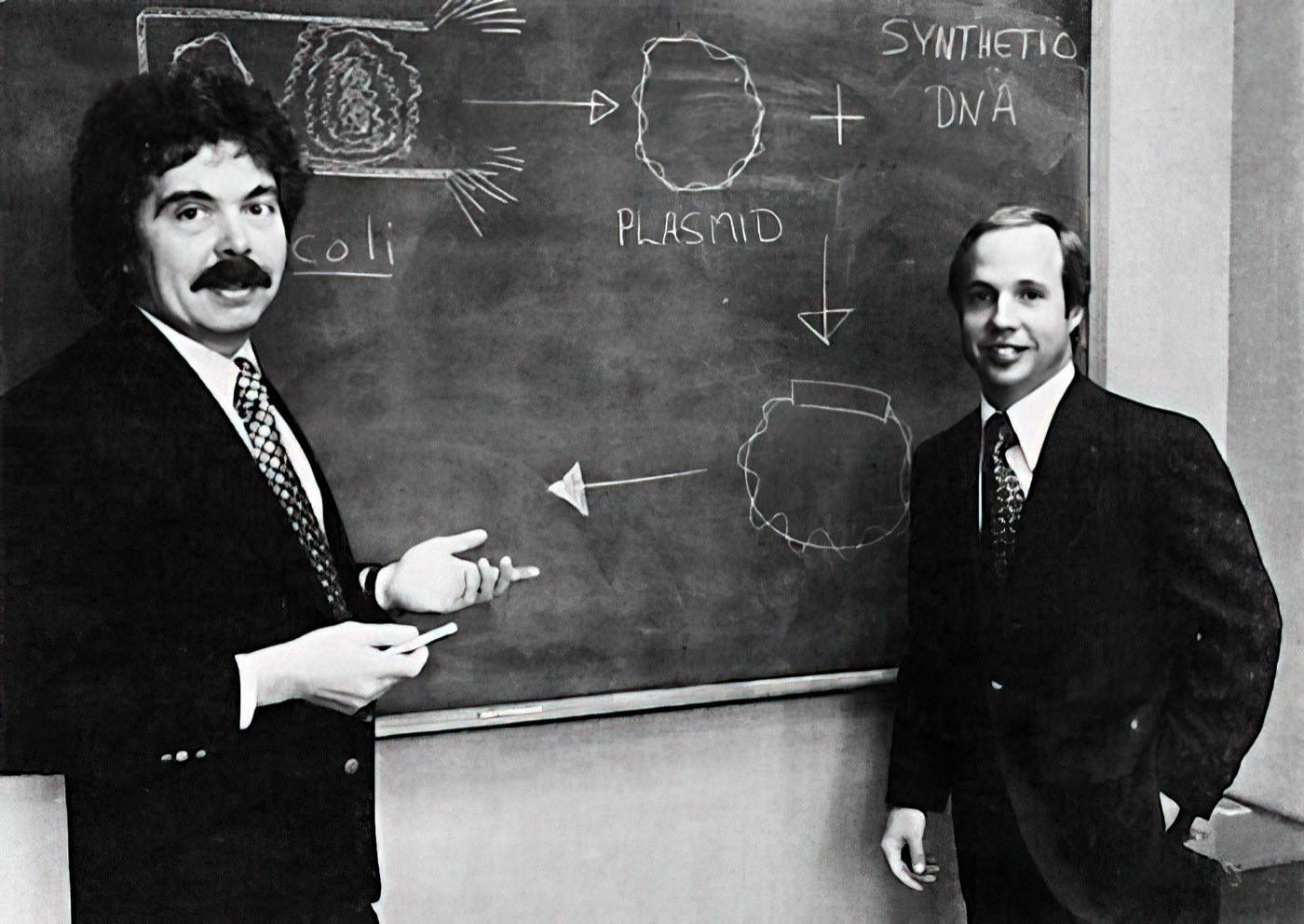
1976
Genentech’s founders set out to make human insulin in bacteria. No one had ever done it.
Look where we are today. That is the kind of question I want us asking about trials.
The answer is there. Reaching it is too slow.
Trials lose time to slow communication. When one person in a trial needs an answer from another, the question travels from inbox to inbox.
The sponsor is the company that pays for and runs a study, the site is the hospital or clinic where patients are seen, and the CRO is the contract research organization a sponsor hires to manage the work.
Friday, 6 PM. A coordinator at a clinical site has a patient on the phone, and a question:
A patient on the study drug has had diarrhea 6 times today. Her usual is 1. Is that Grade 2 or Grade 3 under the protocol? And does she take tonight’s dose?
Grade is how severe an event is, from 1 to 5. In this study, Grade 2 means keep dosing. Grade 3 means stop.
The coordinator emails the CRO. 2 hours later, the CRO passes it to the sponsor. No answer by 9 PM. The investigator holds tonight’s dose to be safe, and the site asks again. The sponsor reads it Saturday morning and asks its medical monitor, the physician a sponsor keeps on call for questions like this. The medical monitor replies Monday at 8 AM. The answer reaches the coordinator at 9 AM.
63 hoursand 3 missed doses, for one question
Every piece of that answer already exists. Give the coordinator the sponsor’s protocol, the study’s own data and an FAQ to ask directly, and it comes back while the patient is on the line.


Nobody in that chain did anything wrong. Each person sent the question to the right next person. The system still took a weekend, and the patient spent it off her study drug.
63 hours to instantaneous response.
The coordinator shouldn’t have to wait on anyone for an answer that already exists. Ask once, get it with its sources, and go do the work. When a case truly is new, it still goes to the medical monitor, with everything they need to answer it that evening.
That weekend is ordinary. Here is what a day looks like for the people who run a trial at a sponsor.
One Tuesday for a clinical trial manager at a sponsor. Every half hour is booked.
These are actually meetings and calls guised as operations.
More than half of this day is communication: emails, calls, meetings and follow-ups.


Now make the routine communication asynchronous: written updates, read when there is time. 2.5 hours open on this Tuesday.


The clinical trial of tomorrow must be seamless, synergistic and synchronized.
Seamless
Meet them where they are.
Today, the patient travels to the site.
Adaptive and decentralized designs, so the trial travels to the patient instead of the patient traveling to the trial.
Seamless means meeting patients where they are, reducing patient burden instead of increasing it at a time when they already have too much going on.


Synergistic
Sponsors, sites and CROs as partners.
Today, work passes down a chain, one organization at a time.
When I was a coordinator, the best thing that happened to one hard-to-enroll study was a monitor who treated our site as a partner. She mentored me through every challenge, and we ended up a top-enrolling site.
Synergistic means sponsors, sites and CROs as partners: the same people, in the same room, with the same incentive, rather than three organizations managing each other.


Synchronized
One set of facts, available to everyone.
Today, each organization keeps its own copy of the facts.
Day 26 of a 28-day screening window. One question is left: does her adjuvant chemo count as a prior line of therapy? The coordinator asks the CRA, the CRA asks the CRO’s medical monitor, who asks the sponsor. The answer arrives on day 31, and she rescreens.
That same Saturday, another patient is admitted overnight. The serious event form goes in within 24 hours. The causality question comes back Monday, the investigator answers Tuesday, the sponsor’s physician reads the case Wednesday. Both answers were already in someone’s files.
Synchronized means one set of facts, available to everyone: sponsor, CRO and site working from the same information at the same moment, without waiting on each other.


In the AI age this matters more. A model fed two records that disagree will answer confidently from either one. It needs one source of truth: readable data, good metadata, sources you can trace.
The data already exists. Why is it not accessible now?
Sustainable
Less burden. Lower carbon. Stronger science.
Put those three together and everyone speaks the same language, with far less paper to carry it.
“Novo Nordisk’s former chief scientific officer once noted that the documentation required to request approval for two insulin products, if printed and stacked, would rise higher than the Empire State Building.”
At a tenth of a millimeter a sheet, that is roughly 3.8 million pages.
Most of it does not have to exist. AI and new ways of working can take the printing, filing and re-keying out of a trial.


Where the weight comes off
One completed Phase 3 heart failure trial, measured from start to finish, came to 2,498 metric tons of carbon dioxide equivalent. The same as 582 gasoline cars driven for a year, or one car driven 10 million km.
| Paper | Documentation and communication came to 64 metric tons in that trial. |
|---|---|
| Travel | Site monitor visits were the largest line in that trial, 519 metric tons, mostly by car. Patient visits added 143. |
| Meetings | In-person trial meetings came to 404 metric tons in that trial. |
| Shipping | Study drug, samples and test kits came to 752 metric tons in that trial, mostly freight. |
Take those lines down and the column looks like this. About 60% less carbon, if every one of those lines moved. From 582 cars on the road for a year to 236.


If every late-stage industry trial started in 2025 ran this way, that is about 350,000 cars off the road for a year.
1,009 trials × 1,486 t CO₂e saved each ÷ 4.29 t per car = 349,504 cars.
“We’ll find a way. We always have.”
Medicine is helping us live longer. Those extra years mean nothing on a planet that cannot support us.
Longevity means nothing without sustainability.
In closing

Now, how many of you would participate in a trial that is seamless, synergistic and synchronized?
I know I would take part in this trial. Would you?
“I believe that man will not merely endure: he will prevail.”
That’s how to run resilient clinical trials for resilient human beings.
 Read nextWhat does the clinical trial of tomorrow look like?The future of clinical trials